
Drivbiwire
Zehntes Jahr der Veteran
- Joined
- Oct 13, 1998
- Location
- Boise, Idaho
- TDI
- 2013 Passat TDI, Newmar Ventana 8.3L ISC 3945, 2016 E250 BT, 2000 Jetta TDI
A question was asked the other day and I replied to it, after rereading it I thought posting it in the 101 section would be a good way to find the post with a forum search for new members under the header of "Injection Pump".
Enjoy!
Repair for Pump case Pressure Regulator: http://pics.tdiclub.com/data/500/VE_Pressure_regulator_Repair.pdf
ALH (TDI) - Manual Pump exploded diagram and parts list: http://pics.tdiclub.com/data/500/Manual_Pump_Parts.pdf
ALH (TDI) - Automatic Pump exploded diagram and parts list: http://pics.tdiclub.com/data/500/Automatic_Injection_pump_038_130_107_J.pdf
AHU/1Z (TDI) - Manual Pump exploded diagram and parts list: http://pics.tdiclub.com/data/500/1Z_TDI_Injection_Pump_Manual_transmission.pdf
AAZ (IDI) - Manual Pump exploded diagram and parts list: http://pics.tdiclub.com/data/500/AAZ_Injection_Pump_Manual_Transmission.pdf
ME (IDI) - Manual Pump exploded diagram and parts list: http://pics.tdiclub.com/data/500/ME_IDI_Injection_Pump_Manual_Transmission.pdf
Information is relevant for the A3/B4 and also the A4 TDI using the VE series injection pump.
PD motors replace this pump with more advanced individual pump injector units.
Inside the TDI injection pump there is a "Cam Plate" that is turned by the pumps timing belt pulley. The cam plate is also turning a small "Plunger", these two assemblies rotate in unison. The rotating plunger is mounted to a stationary plate or "Roller Ring" that has four rollers that provide the contours for the spinning cam plate to follow and cause the plunger to extend in and out on. The cam plate contours are what determines how far the plunger slides in and out of the fuel compression chamber and the size of the contours are what can vary from year to year effectively determining how hight the fuel pressures can reach. Since the roller ring assembly (fig 2) is "mostly" stationary the compression of the small amounts of fuel can occur at exactly the same time. The caviate to this is that the roller ring assembly can be rotated slightly clockwise or counter clockwise effectively adjusting when the compression of the fuel actually occurs without having to integrate a complex system for injection timing.

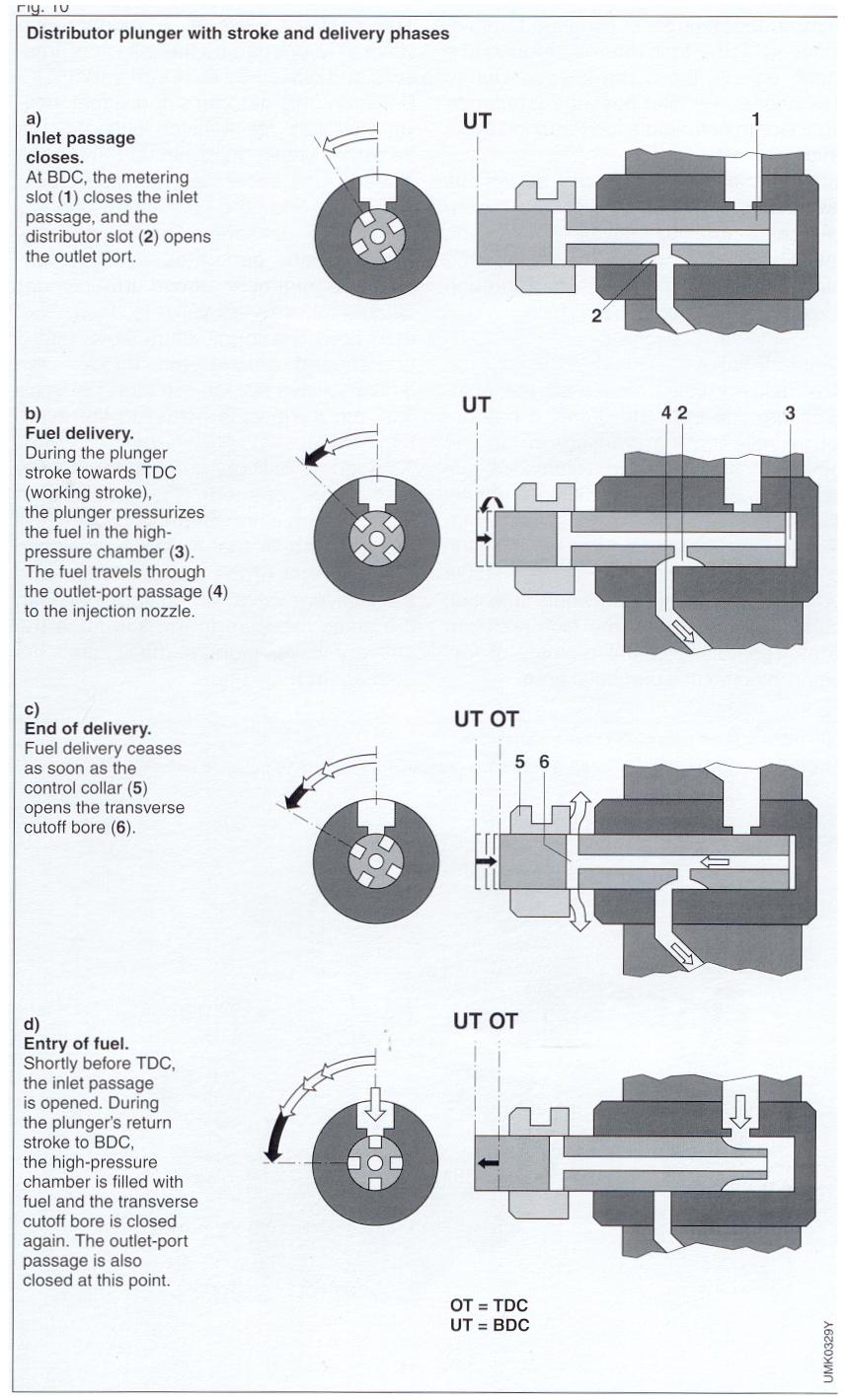
The looming question is how do you control the quantity of fuel ie speed of the motor? The above describes how you effectively create fuel pressure and adjust timing but the next key is the "Fuel Collar" (Fig 7). The fuel collar is a simple ring that the plunger slides through during each and every injection stroke. In the plunger there is an elongated hole (figure 5, top) that when uncovered allows all remaining fuel in the compression chamber to be vented back into the internal body of the pump effectively ending the fuel delivery for that cylinder. This means that all unused fuel is simply vented internally without having to flow to and from each injector. The injectors ONLY recieve what is needed and the fuel collar is what directly determines engine speed and power output.
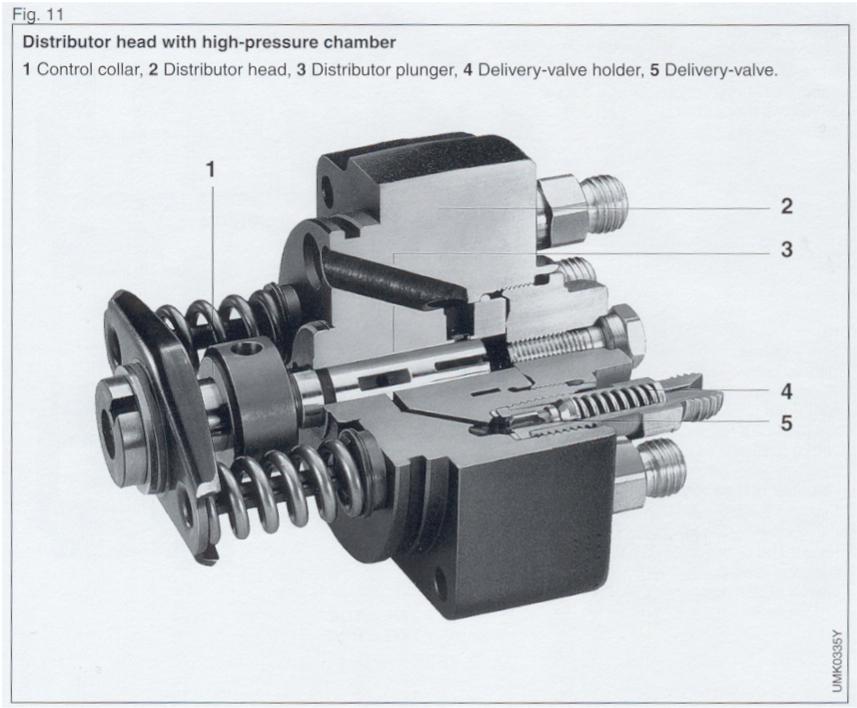
So internally you have an oscilating and rotating plunger that aligns with the four or in some cases 5 or even 6 outlet ports depending on the pump layout. In the case of the VW ALH TDI, with every complete horizontal stroke of the plunger, the plunger itself rotates 90 degrees. This means that it goes from start point to full extension and back as it rotates a complete 90 degrees of rotation. With one full 360 degrees of rotation the plunger will actuate 4 complete injection events while varying timing and injection quantity on each and every stroke.
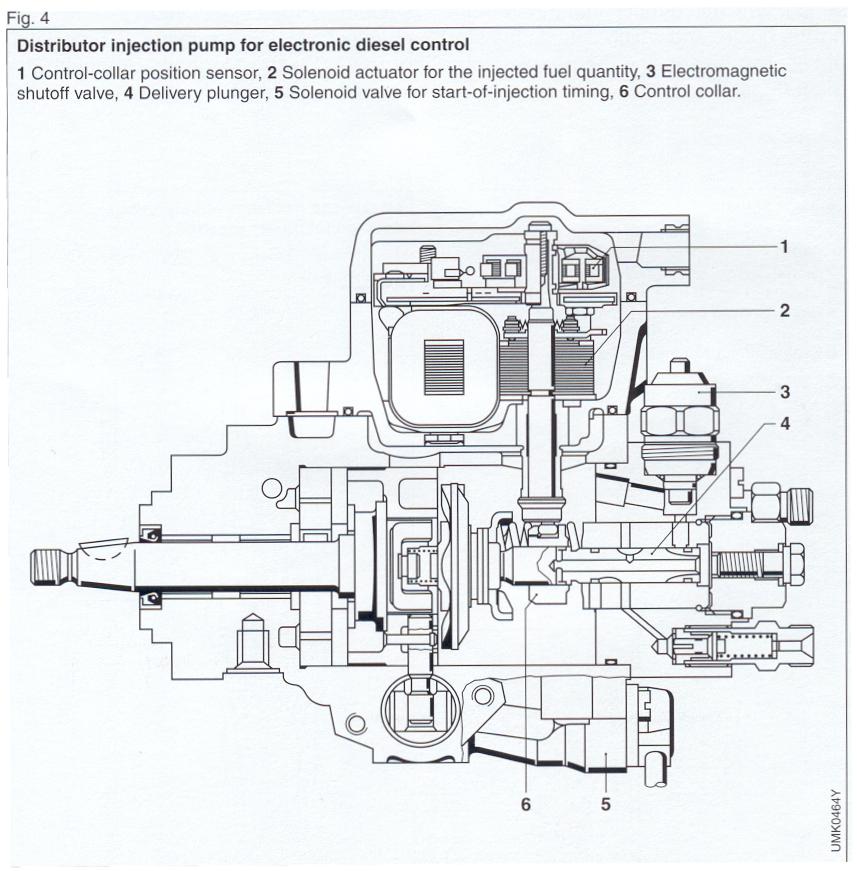
The collar is controlled by an electrical servo that receives its control signal from the cars ECU. The computer looks at all engine sensors and determines when and how much fuel to inject.
On each injector there are fuel return lines. Since the insides of the injectors are not perfect there is sometimes some fuel that is leaked internally. Rather than allowing that fuel to remain in the injector Bosch allows for a return line to return that fuel back to the cars fuel filter where it is recirculated, filtered and eventually burned in the engine.
The pump can be described as having 2 seperate pumps. The first is often described as a "Low Stage Vane type pump" This provides "Head Pressure" to make the fuel push its way into the plunger chamber fast enough not to allow cavitation of the plunger. The pressure of the pump is around around 100 psi. When the plunger compresses the fuel the pressures can reach as high as 19,000 psi at the fuel nozzle.
Hope that helps.
DB
Enjoy!
Repair for Pump case Pressure Regulator: http://pics.tdiclub.com/data/500/VE_Pressure_regulator_Repair.pdf
ALH (TDI) - Manual Pump exploded diagram and parts list: http://pics.tdiclub.com/data/500/Manual_Pump_Parts.pdf
ALH (TDI) - Automatic Pump exploded diagram and parts list: http://pics.tdiclub.com/data/500/Automatic_Injection_pump_038_130_107_J.pdf
AHU/1Z (TDI) - Manual Pump exploded diagram and parts list: http://pics.tdiclub.com/data/500/1Z_TDI_Injection_Pump_Manual_transmission.pdf
AAZ (IDI) - Manual Pump exploded diagram and parts list: http://pics.tdiclub.com/data/500/AAZ_Injection_Pump_Manual_Transmission.pdf
ME (IDI) - Manual Pump exploded diagram and parts list: http://pics.tdiclub.com/data/500/ME_IDI_Injection_Pump_Manual_Transmission.pdf
Information is relevant for the A3/B4 and also the A4 TDI using the VE series injection pump.
PD motors replace this pump with more advanced individual pump injector units.
Inside the TDI injection pump there is a "Cam Plate" that is turned by the pumps timing belt pulley. The cam plate is also turning a small "Plunger", these two assemblies rotate in unison. The rotating plunger is mounted to a stationary plate or "Roller Ring" that has four rollers that provide the contours for the spinning cam plate to follow and cause the plunger to extend in and out on. The cam plate contours are what determines how far the plunger slides in and out of the fuel compression chamber and the size of the contours are what can vary from year to year effectively determining how hight the fuel pressures can reach. Since the roller ring assembly (fig 2) is "mostly" stationary the compression of the small amounts of fuel can occur at exactly the same time. The caviate to this is that the roller ring assembly can be rotated slightly clockwise or counter clockwise effectively adjusting when the compression of the fuel actually occurs without having to integrate a complex system for injection timing.
The looming question is how do you control the quantity of fuel ie speed of the motor? The above describes how you effectively create fuel pressure and adjust timing but the next key is the "Fuel Collar" (Fig 7). The fuel collar is a simple ring that the plunger slides through during each and every injection stroke. In the plunger there is an elongated hole (figure 5, top) that when uncovered allows all remaining fuel in the compression chamber to be vented back into the internal body of the pump effectively ending the fuel delivery for that cylinder. This means that all unused fuel is simply vented internally without having to flow to and from each injector. The injectors ONLY recieve what is needed and the fuel collar is what directly determines engine speed and power output.
So internally you have an oscilating and rotating plunger that aligns with the four or in some cases 5 or even 6 outlet ports depending on the pump layout. In the case of the VW ALH TDI, with every complete horizontal stroke of the plunger, the plunger itself rotates 90 degrees. This means that it goes from start point to full extension and back as it rotates a complete 90 degrees of rotation. With one full 360 degrees of rotation the plunger will actuate 4 complete injection events while varying timing and injection quantity on each and every stroke.
The collar is controlled by an electrical servo that receives its control signal from the cars ECU. The computer looks at all engine sensors and determines when and how much fuel to inject.
On each injector there are fuel return lines. Since the insides of the injectors are not perfect there is sometimes some fuel that is leaked internally. Rather than allowing that fuel to remain in the injector Bosch allows for a return line to return that fuel back to the cars fuel filter where it is recirculated, filtered and eventually burned in the engine.
The pump can be described as having 2 seperate pumps. The first is often described as a "Low Stage Vane type pump" This provides "Head Pressure" to make the fuel push its way into the plunger chamber fast enough not to allow cavitation of the plunger. The pressure of the pump is around around 100 psi. When the plunger compresses the fuel the pressures can reach as high as 19,000 psi at the fuel nozzle.
Hope that helps.
DB
Last edited:


